


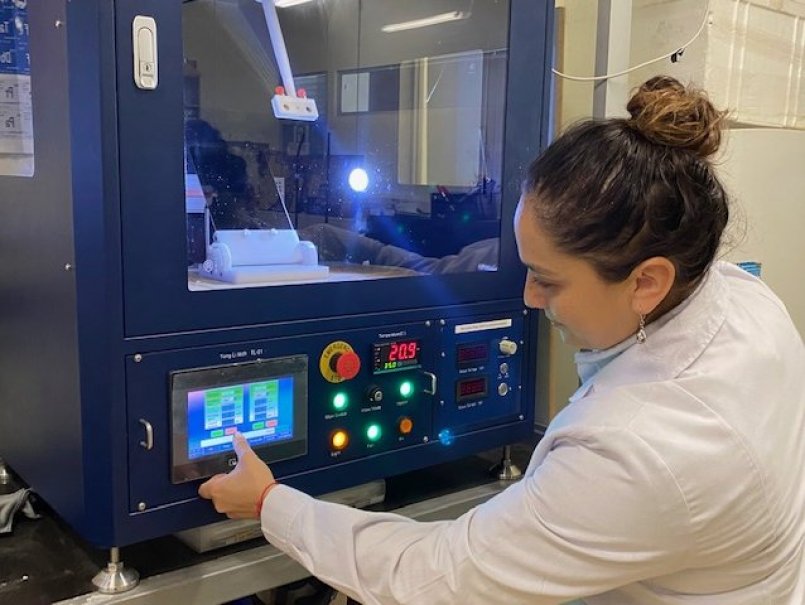
A scientific research project focused on reducing the rate of defects in medical prosthetics through a chemical solution and the use of biomaterials similar to human bones, is led by Professor Lisa Muñoz, from the Institute of Chemistry at our university.
This is a Regular Fondecyt project that proposes the use of high entropy alloys – metallic materials formed by five or more elements in equal proportions – similar to the human bone, coated with a polymeric fiber created by electrospinning technique. This coating works as a protective dressing that adheres to the prosthetic and releases essential oils with antibacterial properties to prevent infections and avoid biocorrosion of the implant.
“Out of a hundred prosthetics used, 20 fail due mainly to intra-hospital infections and osseointegration, which has both a financial and emotional cost for affected people. Our research aims to develop a technology that, from chemistry, contributes to reduce these problems”, Lisa Muñoz stated.
The researcher – who is also a professor at the Chemistry Doctoral program at the PUCV – highlighted that, although it is a basic sciences project, the study she leads has projections to be applied both in hip and knee bone replacements, as well as dental implants.
“When bacteria enters the blood flow, it can move inside the body and in areas where there is a different external agent than the human body – such as a prosthetic – there is always going to be a trend to host external parasites. Then, taking an antibiotic, orally or by injection, will not be as efficient when there is already a colony of bacteria since the area of the implant tends to have less blood irrigation”, Muñoz explained.
Antibacterial Action
Under the name “Improvement of high entropy alloy properties for the liberation of antibacterial agents, perspectives for the design of new biomaterials”, this project aims to add a chemical functionality to implants, making superficial modifications and adding a layer that is manufactured from a system known as electrospinning, that creates a polymeric fiber infused with essential oils with extended release antibacterial properties.
The researchers added that “in this way, not only the prosthetic is antibacterial, but we can also release of this agent to the blood flow; and in this way we prevent the bacteria from colonizing the muscle, and we contribute so that the body does not reject the implant and we extend the life of the prosthetics”.
“My project centers around studying new alloys that are similar to bone in order to avoid osseointegration problems or loosening problems, but that have, at the same time, a functionality that is given to it by chemistry, superficially modifying the implant with polymeric fiber infused with antibacterial agents”, the scholar specified.
Lisa Muñoz explained that they are researching on two different fronts. On one hand, they study how to inhibit bacterial colonization through the use of fiber, and on the other, they aim to stop biocorrosion, which is the degradation of metal due to bacterial colonization. The expert clarified that metals are attractive for bacteria for the formation of a biofilm and proliferate. This is why having an antibacterial agent is useful to inhibit the biocorrosion process.
Dental Implants
Although the project is focussed on bone prosthetics, the scholar indicated that they are also studying applications to improve dental Implants. “There is a system called tribocorrosion that acts on teeth and considers three agents: the acidity of the mouth (pH), the chewing movement and the bacterial colonization associated to hygiene. In these cases, osseointegration is very important, because the most common problems happen because the bone was not able to interiorize the prosthetic and it ended up shifting. Therefore, the coating must be resistant to acidity”, Muñoz underscored.
In the same way, the researcher highlighted that for the manufacture of prosthetic coatings, they use polymers that are approved by the Food and Drug Administration (FDA) in the United States, mainly polyethylene glycol and polycaprolactone, which are biodegradable. “The body will not consider them an external agent and protect itself but will take them as part of their own and it will not generate inflammation”, she added.
This study is characterized by gathering various disciplines and experts from different universities. Led by the Chemistry Institute at the PUCV, the project welcomes the contribution from Professor Claudio Aguilar, from the Universidad Federico Santa María, who collaborates in prosthetics development; Eugenio Hamm from the Universidad de Santiago, dedicated to the study of adherence; Laura Tamayo, from the Universidad de Chile, that contributes from microbiology; and Scott Kimmins, from the Chemistry Institute at the PUCV, in charge of the polymer area.
By Erika Schubert
Strategic Communication Department


