

In an effort to redefine public transportation under sustainability and efficiency criteria, the Mobility and Transportation laboratory led by scholars of the School of Construction and Transportation Engineering, Sebastián Seriana and Vicente Aprigliano, is developing a project that seeks to integrate the bicycle to the train.
The study uses full-scale experimentation to demonstrate that bicycles can cease to be a hindrance and become a catalyst for change within the system, altering the perception of cyclists on public transportation.
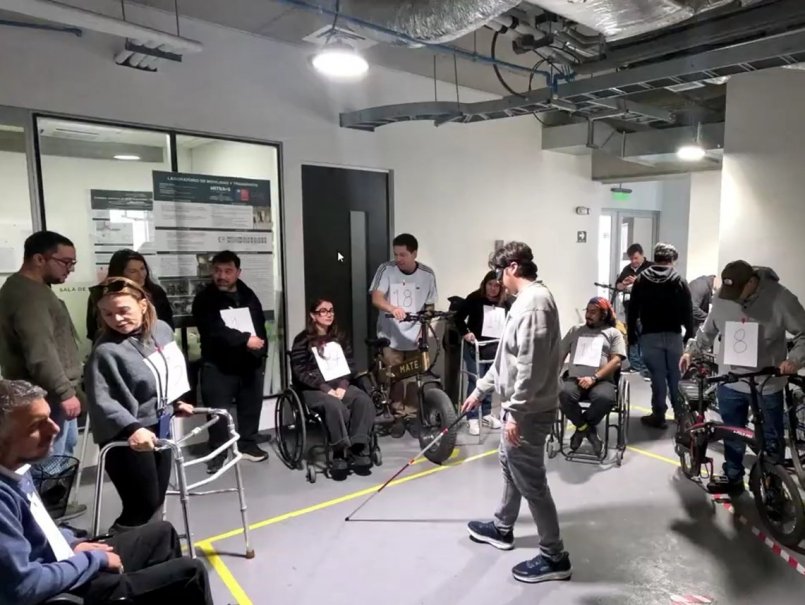
Through experiments in a full-scale train car, the team analyzed how to modify the train's internal design so that cyclists do not inconvenience other passengers, proposing physical solutions such as removing seats to create dedicated spaces and installing channels on stairs to facilitate movement.
Good designs, good behavior
According to Sebastián Seriani, the project first carried out an experimental analysis of everything related to the stations of the Metro de Valparaiso (Train from Limache to the Port of Valparaíso) to see how the design affects passenger behavior, studying variables such as door width, handle placement and seat placement. Their work is also centered on universal access, evaluating how people effectively have access and use the transportation system.
“In addition to the train car, the study proposes improvements to the circulation infrastructure, such as the incorporation of rails or channels along the edges of the stairs. This allows the cyclist to dismount and descend or ascend through the stairs and use the rails or channels to safely move their bicycles, avoiding the need to use elevators and damage existing infrastructure. Good design leads to good behavior, meaning that signs or paint alone are not enough; physical changes to the environment are required to encourage certain behaviors,” Seriani explained.
The initiative seeks to expand the influence area of the stations, allowing people who live farther away to use bicycles to access the metro. The ultimate goal is to demonstrate that good infrastructure design induces better behaviors and facilitates efficient multimodal mobility. To achieve this, researchers are collaborating with EFE (Chilean State Railways) to evaluate the technical feasibility of these improvements to the rail system.
Flow dynamics
For Ivan Bastías, student of the Masters of Transportation Engineering Program at the PUCV and member of the research team, his participation centers on analyzing passenger flow dynamics through controlled experiments that simulate boarding and descent of passengers from trains with various elements, such as bicycles or reduced mobility devices.
“Through the use of Artificial Intelligence cameras, the team seeks to quantify maneuver times, comfort levels and the impact of these factors in train frequency, also addressing aspects such as sustainability and environmental factors, such as noise on train cars, to propose improvements on public infrastructure”, Bastías added.
The project included field studies where data and the characteristics of stations were identified in order to define its area of influence; lab experimentation with a train car at real scale; and inclusion of other cycles with the goal of testing new space configurations that not only benefit cyclers, but also people in wheelchairs or strollers.
Collaboration with EFE Valparaíso
Regarding the actual implementation, Seriani highlighted the collaboration with the company EFE Valparaíso, “with whom we have held working sessions to renovate bicycle parking outside stations and explore the possibility of integrating bicycles onto the train. The idea of a special carriage or structure exclusively for bicycles, which could be attached to the train, was even raised.”
The possibility of allowing bicycles on the train on weekdays during off-peak hours is also being analyzed, in order to expand the current policy that only permits bicycles on weekends.
Finally, professor Seriani insisted that continuity of travel is one of the greatest advantages of integrating the bicycle to the train and that the goal is to improve the quality of life of users through a deep understanding of human behavior in public transportation.
“The main benefit is to allow a “door to door” trip, combining sustainable modalities, considering an influence area that can reach, for example, up to 5 kilometers around stations. However, this also requires that there are cycle paths to connect and offer continuity to the urban infrastructure”, he emphasized.
The study considered the opinions of cycling groups such as Andes Chile NGO, whose representatives emphasized that integrating bicycles with the Valparaíso Metro (Limache-Puerto Train) can become an efficient and sustainable solution to the rising cost of living and transportation, allowing for combined train and bicycle journeys to reduce dependence on buses, minibuses, and cars. They also praised initiatives like the National Bicycle Forum for promoting intermodality in Greater Valparaíso, fostering safer, more accessible, and inclusive mobility, in line with experiences in other Latin American cities where rail transport allows bicycle access at all times.
The study led to a first article funded by ANID Initiation Fondecyt project number 11230050, which can be reviewed here: https://www.mdpi.com/2071-1050/16/24/10870
Por Erika Schubert
Strategic Communications Department