

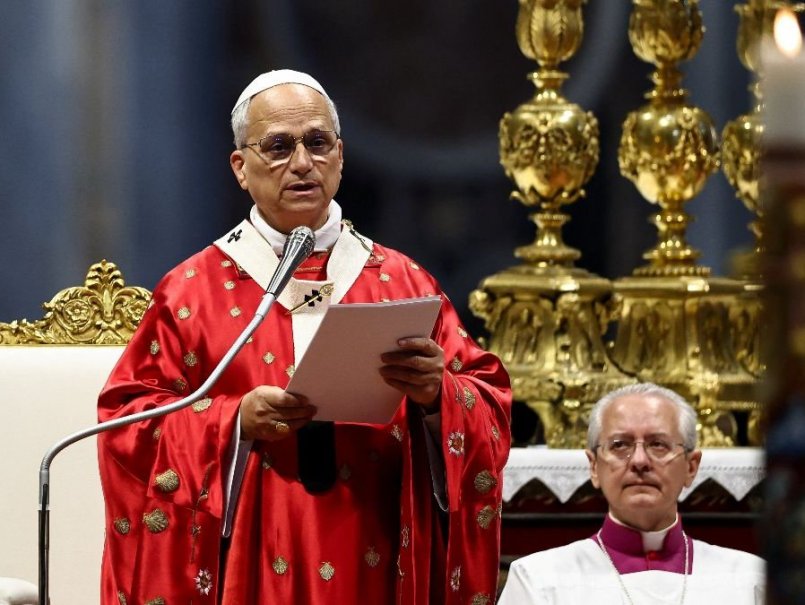
In line with the Church’s universal magistery, the Pontificia Universidad Católica de Valparaíso welcomes with profound attention and a sense of mission, the publishing of the first Encyclical by Pope Leo XIV, titled “Magnifica Humanitas” (Magnificent Humanity).
Signed symbolically on May 15 – coinciding with the 135th anniversary of the social encyclical Rerum Novarum by Leo XIII – and officially presented at the Holy See, the document addresses the care of the human being in the artificial intelligence era. This is a dynamic social text that poses an urgent calling that resounds strongly in our identity as a university community in the midst of the 21 st century.
The Holy Father clearly warns us that AI developments and frontier technologies “are not neutral, because they take on the face of who conceives, funds, regulates and uses them”. Through this analysis, Leo XIV presents the great dilemma of our time: allowing to be dragged down by technical progress as an absolute end in itself, recreating the risks of a new “Babel Tower”, or building the celestial “Jerusalem”, responsibly creating a society that situates the person and their inalienable dignity at the center of all innovation.
Regarding the Encyclical, Vice Grand Chancellor Cristian Eichin ofm expressed that in the line of the Social Doctrine of the Church it is valuable to reflect on the AI and its effects.
“The text highlights the dignity of the human person above all technological advances and follows a line in relation to what Pope Leo XIII proposes in the face of the new industrial and technological revolution we are going through. The challenges are related to humanizing AI use, not replacing human intelligence and the ethical decisions that must be applied in relation to this technology. Although it facilitates some processes and represents progress in topics such as medicine, it cannot replace the human person”, he added.
A calling that questions academic and research work
For our community, the Encyclical represents an ethical challenge of great importance. The pontifical document warns us against the “technocratic paradigm” – where efficiency and profit prevail – and insists on the necessity that knowledge must not be concentrated in the hands of a few, feeding the digital gap. In addition, it reminds us that, although AI simulates to be human, it lacks moral conscience, empathy or a spiritual dimension.
As a university of excellence and profound public vocation, this teaching encourages us to lead the creation of knowledge under strict criteria of social justice and environmental sustainability, considering the high consumption of energy and water these systems require.
Training and research at the PUCV must continue to promote a strong interdisciplinary dialog. This ensures that every designed or implemented algorithm in our classrooms is originated under the perspective of common good, unrestricted respect for human rights and the protection of creation, without falling into the transhuman movement that forgets that human beings blossom precisely through the acceptance of their own limitations and fragilities.
Key actors in the digital era
The Encyclical is not limited to technical dimensions; it directly touches our everyday interactions and the work world. To the community, the Holy Father talks from the concern for dignifying labor in automatized contexts. He upholds the idea that technology must supplement and strengthen talent in people and never lead to unemployment in the name of cost reductions. Technology must be at the service of the meeting culture, protecting the family as a primary social good.
In the same way, our students are called to be the main protagonists in receiving this message. “Magnifica Humanitas” advocates for an “economy of communication” that fights hate, data manipulation and disinformation in the digital environment. The text invites young people to build critical and dynamic thinking, promoting an “educational alliance” and “AI fasting” when appropriate, reasserting school and university as irreplaceable spaces for shared time and reliable relationships.
Disarming technology to build peace
A key point in the Encyclical is the categorical call to “disarm the AI”, demanding that it stays external to military competence and mass surveillance. Leo XIV is emphatic: “there is no algorithm that can make war morally acceptable”. In times of hybrid conflicts and multilateralism crises, the Pope invites us to overcome the theory of “fair war” through diplomacy, interreligious dialog, and active resistance to evil, firmly taking the perspective and voice of victims.
The great challenge we take on as a community is to continue to teach future generations under the conviction that technology is only truly great when it serves as a testimony of the beauty of a magnificent humanity inhabited by God.
You can find the complete text of “Magnifica Humanitas” in the following link.
Strategic Communications Department