

A study centered on analyzing the mistralian marginalia formed by annotations, underlining and comments by the poet inside the books that were part of her personal library, seeks to reconstruct a poetic of her reading to understand how Gabriela Mistral received and transformed that knowledge and how these reflections influenced her own literary creation.
This is a DI Research project funded by the PUCV through the Vicerectorate of Research, Creation and Innovation, that highlights the author as an intellectual humanist and explorer of topics that go beyond the traditional cannon, such as mysticism, religions and traditions of Orient, and ecology.
Ana María Riveros, faculty member of the Literature and Language Sciences (ILCL, for its name in Spanish) and Director of the Spanish and Communication Program at the PUCV, leads this project that seeks to contribute new interpretative keys about Chile’s literary heritage.
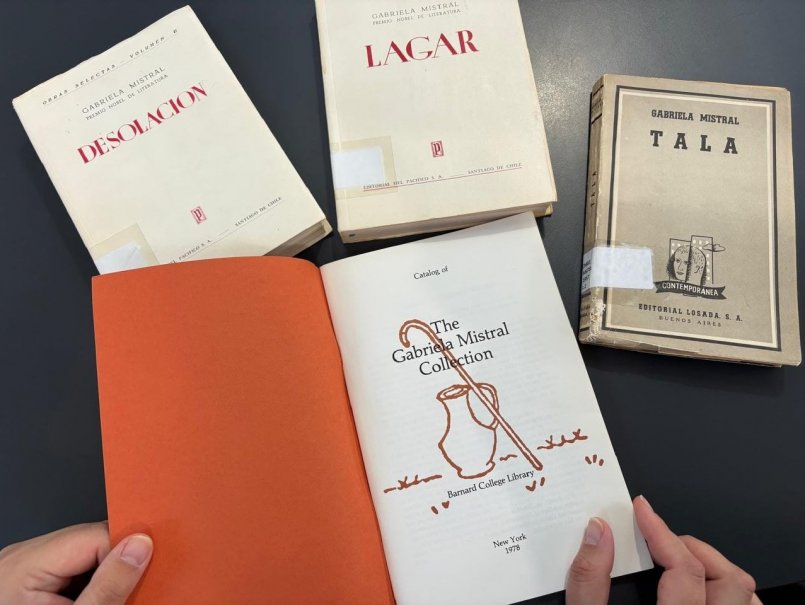
The study centers on the review of Gabriela Mistral’s personal library, specifically books owned by the poet during her time living in the United States, from 1946 until her death in 1957. This collection of about a thousand books, was selected by Doris Dana – friend and personal secretary of the poet – and donated to Barnard College of Columbia University, in the United States, finally returning to Chile in 2010 thanks to the actions of Doris Atkinson, niece and heir to Dana. The texts are currently in the Isolina Barraza library at the Gabriela Mistral Museum in Vicuña.
Poetics of reading
The central purpose of the project is to analyze these records to raise keys that can allow us to talk about the poetics of reading in Mistral, exploring her side as an active reader. It seeks to understand how the Nobel Prize recipient built, when reading, her own meanings and how these reading practices influenced her lyric production.
“The particularity of these books lies in the fact that the majority have handwritten annotations, comments, underlining, and margin notes penned by Mistral herself with blue carbon pencil. The proposal is to analyze those texts to raise keys that will allow us to talk about poetics in Mistral’s reading and view her as a reader”, Ana María Riveros explained.
Research addresses a variety of texts: literature, ecology, geography, religion and mysticism. In addition, it seeks to articulate these readings with recurring topics in the work of Gabriela Mistral, such as criticism to the patriarchal logic and her interest in non-western spiritualities such as Buddhism.
At this respect, the scholar underscored that Mistral’s reading was not passive: “She transformed the meaning in a dialog with the text, which is reflected in her marginalia, and from that point of view, studying the elements that are present, the components that form this marginalia, allows us to raise a proposal regarding poetics of reading, this is how Mistral read texts of different genres, authors and topics, and how that reading experience was highly meaningful in building a poetic that runs through, in one way or another, all the literary production of the author”.
Micro literature
Regarding the impact and relevance of this project, the research proposes to consider the marginalia as a literary genre or micro-literature, which allows to re-read Mistral and go beyond what has been addressed by literary critics so far. This with the goal of discovering and linking the reading of the poet with the cartesian, western and eastern unanchoring keys, perspectives that in the mistralian studies field have gained strength during the last 40 years. Then, this project seeks to address a research space that has been mostly un-inquired about and that has great heritage value.
“I even think about possible didactic projections for Language and Communication students, to take advantage of the mistralian marginalia, that micro literature as an input for the teaching of literary reading and writing”, the professor emphasized.
The work methodology includes visits to the library of the Gabriela Mistral Museum for text digitalization and archive record, as well as a seminar in the city of Vicuña to share research findings with the community and other specialists in the field.
By Erika Schubert
Strategic Communications Department