


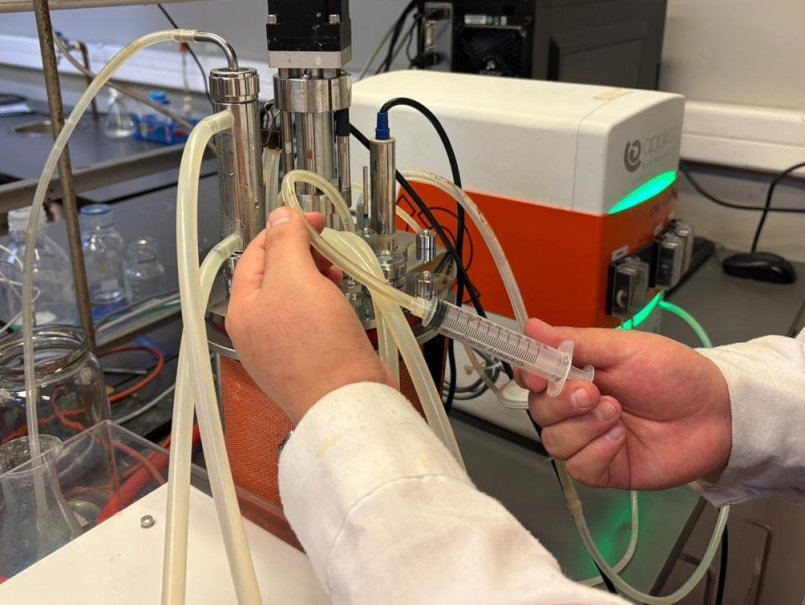
A fundamental principle of nature is evolution, and at the biological level this corresponds to the process of change that organisms experience in their hereditary features. Within this context, Stephanie Braun, professor at the School of Biochemistry Engineering at the PUCV, leads a project that seeks to make the most of this principle and recreated it in lab controlled conditions to create new capacities in biotechnological yeast Komagataella phaffii (also known as Pichia pastoris), that is a species widely used in the industry to produce proteins of interest.
This work will be carried out thanks to the awarding of a Regular Fondecyt Project and is titled “Engineering Fit-for-purpose Komagataella phaffii strains with Enhanced Methanol Assimilation for Biomanufacturing”. Professor Braun explained that the project seeks to create variants of yeast that is more robust, grow better and produce more protein when cultivated in the presence of methanol, a key but challenging source of carbon for this organism. To achieve this – she said – “we will combine experimental evolution strategies with Avant Garde technologies, such as Spectral Flow Cytometry and transcriptomic analysis, so as to identify, isolate and study the most promising strains for its potential use in biotechnological processes”.
“This topic is Relevant because it responds to the increasing need of producing various proteins in a more efficient, economical and sustainable way. The Komagataella phaffii yeast is broadly used in the industry, but still presents important limitations. To make progress on these would allow to optimize key processes in the production of medication, vaccines and enzymes”, the scholar added.
The potential social impact of this research could also be significant since greater production efficiency can reduce costs and facilitate access to various biotechnological products. Furthermore, an improved production process leads to lower resource consumption and a reduced environmental impact. “From a scientific perspective, this project combines experimental evolution with advanced technologies to generate and select new variants, contributing knowledge about how this species adapts to challenging conditions and which genes are responsible for these changes. This knowledge could be extended to other systems, expanding the tools available in biotechnology,” Stephanie Braun explained.
For her, working in biotechnology allows her to apply diverse disciplinary tools to real-world challenges, to process problems that can explain the difficult access or cost of certain compounds. “I believe this is the starting point that makes us dream of being able to contribute to developing more efficient bioprocesses in the future, which undoubtedly gives greater purpose and motivation to what we do,” she added.
In addition to Stephanie Braun, the national research team is formed by three scholars from the PUCV and USACH and two international collaborators from leading institutions in the United Kingdom and Ireland. “This collaborative work gathers supplementary professional abilities for the development of the project and will also allow access to advanced computer and bioprocesses infrastructure”, the scholar concluded.
By Jenny Díaz
Strategic Communication Department


