


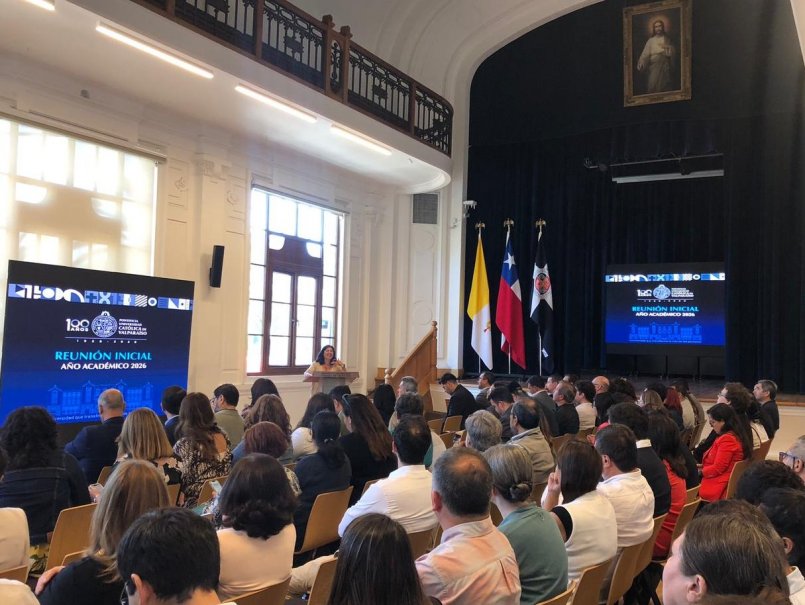
With the purpose of presenting the main Institutional advances achieved during 2025 and planning strategic guidelines for the coming year, the Rectorate invited directives of the academic offices and the central management level. On the occasion, the highlight was on relevant milestones that consolidate the Pontificia Universidad Católica de Valparaíso as the largest higher education institution in the region and one of the top five in the country.
In terms of enrollment, the PUCV placed at number 10 at the national level and number 1 in the Valparaiso region, which means an increase of 7.4% with 4,531 new students. Of these, 80% selected our university as their first choice. Likewise, we saw an increase of 27.6% in the incorporation of women to programs in the scientific field, reasserting the institutional commitment to gender equality in strategic areas.
To this regard, rector (s) Claudia Mejías pointed out that these results reflect an articulated work between Departments and Vicerectorate offices, aimed to attracting and supporting more and better students. She also highlighted the broad support system the PUCV makes available to their students, through scholarships and psico-educational and mental health support programs.
“We began the year by highlighting the important achievements the University made in 2025 and, at the same time, addressing the challenges we face as an institution throughout this year. In this meeting, we wanted to outline the development of the academic year and all the support we institutionally provide to students joining university life at PUCV,” she stated.
During the event, progress in infrastructure was also showcased, in accordance with the historic investment made in 2025, as well as the main results in research, innovation and creation, in addition to the challenges related to the upcoming institutional accreditation, the path of which began to be traced with the mid-term self-evaluation that started at the end of last year.
Proud to be a part of a university of excellence
José Luis Valin, director of the School of Mechanical Engineering, valued the presentation of the 2025 institutional results, which place the PUCV as the largest university in the region. “ This fills us with pride because it places us as participants of these achievements. Students, staff, faculty and directives are part of these advances, as well as the challenges that we face for this new academic year”, he stressed.
Marta Quiroga, academic secretary of the School of Pedagogy, highlighted that “this was a very nurturing meeting since it allows us to have a vision of the PUCV system and corroborate that we are a university of excellence and the most relevant in our region. It is a satisfaction to be a part of an institution of this quality, in which professors working in different departments see that their everyday efforts are crowned with indicators and a prestige that reaches to our students”.
For David Aceituno, from our History Institute, it is key to understand how the national university system works and the position the PUCV has in it. “The general orientation they give us on research and teaching are very important. It is essential to us as faculty to have a shared vision from the first day”, he stated.
Along the same lines, Germán Ahumada, Head of Teaching at the Physics Institute, underscored the importance of these spaces for meeting. “In a changing and very dynamic world it is very important to establish these milestones, so we as scholars can participate of the Institutional vision, the orientations, and know where we are heading to. We are an university of excellence, which is not simple and includes the challenge of constant adjustments, projections and anticipating what will come in the future”.
Pamela Wilson, scholar at the School Industrial Engineering, added that “these types of meetings for the directive teams are highly important to develop excellent planning, which contributes to management and how to reach professors, so they know the rules of the game and how we are positioned”.
The director of the Physical Education School, Jorge Gálvez, highlighted the clarity and organization in the delivery of information. “We work at a university that anticipates and plans its work, motivating scholars that hold leadership roles to continue on this path, pointing to the significant achievements of the university in academics, science, infrastructure and the care for the upcoming accreditation process.
For her part, Carol Agüero, professor and academic coordinator of the Electric Engineering School, commented that “this opportunity allows us to initiate the year with clarity in the face of Institutional challenges, by providing us with guidelines and tangible tools to strengthen student education and aligning to the demands of the university”.
David Luza, director of the School of Architecture and Design, expressed that the achieved results “encourage and reassert the commitment of the academic department”, adding that the institution is well on the way towards a re-accreditation of excellence, which requires that the collaborative work continues.
Lorena González, professor and academic secretary of the School of Food, pointed out that the advances in enrollment, national positioning and investment in infrastructure "reflect a university in growth and consolidation", also highlighting the challenge of maintaining the seven years of accreditation with the commitment of the entire community.
Finally, Máximo Poblete, scholar and Head of Teaching in the Kinesiology program, stated that the 2025 evaluation shows “integral growth in publications, projections, enrollment and infrastructure, which allows to set clear goals and assume new formative challenges with responsibility, especially in the clinical field”.
By Juan Paulo Roldán
Strategic Communication Department


