


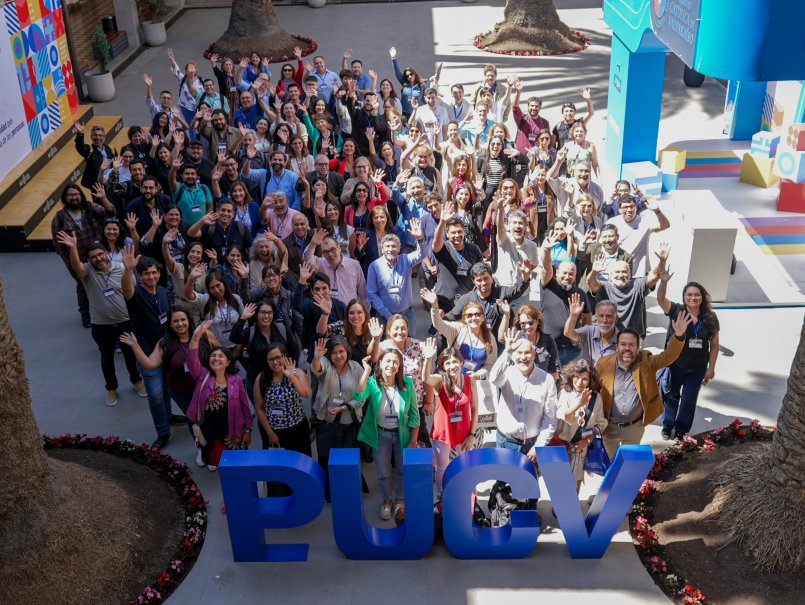
Within the framework of AI Day, an event that featured research presentations and workshops aimed at promoting the ethical, critical, and context-based use of these technologies in education, the “PUCV Decalogue on the Use of Artificial Intelligence in Teaching with a Focus on Academic Integrity” was officially presented.
The document was developed by the Academic Integrity Unit of the University’s Faculty Development Office, under the Vice-Rectorate for Academic Affairs, and was led by Professor Claudia Poblete from the School of Law. Its purpose is to support students and faculty in the ethical use of AI, in accordance with international standards.
The decalogue proposes the following recommendations: clearly define course rules; reinforce PUCV values; assess the learning process, not only the final product; require a declaration of AI use; protect key competencies; promote integrity through personal practice; uphold university autonomy; build ethical commitments; clearly define the review process for written work; and consult when in doubt.
The text was developed over several months and is part of a broader document that brings together literature, perspectives, updated material, and experiences from different university contexts, incorporating practices from other prestigious institutions. Each recommendation reflects a collective effort to promote the responsible use of AI while maintaining the value-based perspective established in PUCV’s academic integrity policy.
During the event, the importance of strengthening critical thinking and professional ethics in the face of technological advancement was emphasized, recognizing that AI should complement, not replace, human work.
At the beginning of the activity, Professor Felipe Muñoz from the School of Civil Engineering engaged in a live conversation with the avatar “Matías,” a doctoral student created especially for the occasion, who interacted in real time with the Vice–Rector for Academic Affairs, Claudia Mejías, in the Hall of Honor.
Rector Nelson Vásquez highlighted that the world of work is undergoing a process of accelerated transformation, in which technology and AI play a central role in optimizing productive, logistical, and knowledge-generation processes. “This technological advancement not only challenges the productive system, but also human relationships,” he warned.
In this context, he stressed the need to adapt educational and institutional management processes. “As a university of excellence, with 98 years of history, we must view AI as an opportunity to strengthen management, research, community engagement, and education at all levels,” he added.
Vice-Rector Mejías noted that in recent years the University has promoted critical thinking and the development of digital competencies, in line with the institutional development plan and academic integrity principles.
“The challenge is for the adoption of AI to foster a rigorous understanding of its operation, applications, and social, economic, and ethical impacts, guiding both our present and future actions,” she stated.
The workshops addressed topics such as critical dialogue between teaching and Artificial Intelligence, prompt design for university teaching, and the creation of AI-mediated learning experiences.
Cristian Merino, Director of Faculty Development, compared the impact of AI to technological milestones such as the arrival of calculators, computers, and the internet. “In higher education institutions, AI represents a challenge for the training of our professionals. It is a technology embedded in the labor market, enabling the automation of many processes. As an institution, we have seen many academics working with this tool for class development, planning, activity design, and assessment.”
PUCV also has an AI Community that has been active for more than two years, developing interdisciplinary projects aimed at teaching innovation and strengthening graduate profiles.
Faculty Voices
Felipe Muñoz from the School of Civil Engineering presented on the use of autonomous avatars in education, emphasizing that the main challenge lies in redefining the skills and competencies to be developed, since access to knowledge is no longer the barrier, but rather the critical ability to use it.
Meanwhile, Daniel Pinto, professor in the Mining Engineering program, addressed the risks, opportunities, and effects of AI on psychological well-being, stressing the importance of analyzing its ethical and emotional implications for both students and faculty.
In his department, AI has been used to support thesis development, rubric design, and teaching organization, reducing administrative workload and promoting competencies such as critical thinking through the use of prompts.
Finally, Claudia Poblete, professor at the School of Law, referred to the tool “ScribeClaroPUCV,” developed to improve students’ academic writing. Initially designed for Law, the platform is now available to the entire student community.
By Juan Paulo Roldán
Strategic Communications Office


