


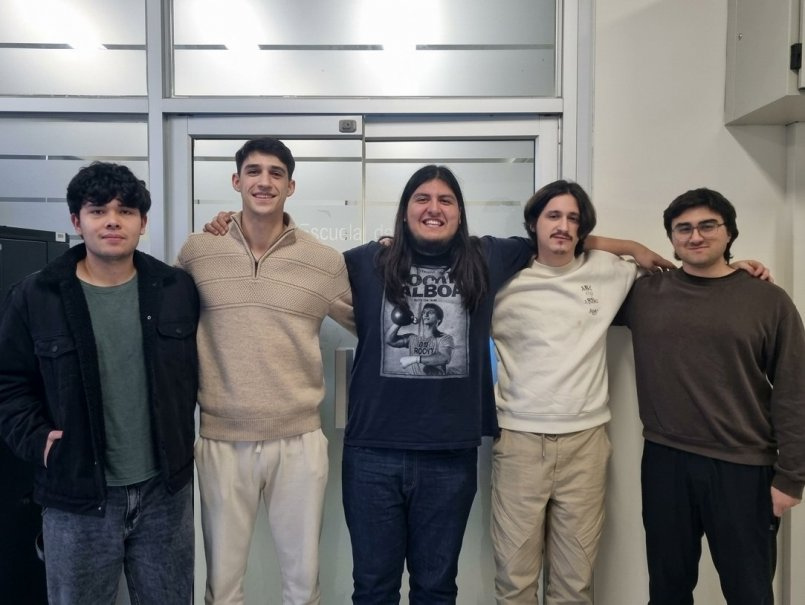
An innovative solution based on deep technology seeks to transform the process of detecting leaks in water networks. Developed by students from the Pontificia Universidad Católica de Valparaíso (PUCV), the proposal combines accelerometer sensors and predictive models to identify micro vibrations associated with the loss of water, without intervening distribution networks.
The team was composed by Nikolai Navea, Daniel Miranda, José Lara, Lucas Erazo and José Villamayor, from the Computer Civil Engineering program at the PUCV. The initiative seeks to contribute to the reduction, at a larger scale, of water waste, operational costs and loss of the hydric resource, through a technological alternative oriented to improve the efficiency of the distribution systems.
The project addresses one of the main challenges the water distribution system faces in Chile: sanitary companies lose, on average, 32% of treated water due to leaks in the secondary distribution networks before they reach consumer homes.
The initiative was born in the classrooms, specifically in the Business, Innovation and Entrepreneurship class, taught by professors Dayan Echeverría and Pamela Hermosilla. When asked about their role as a mentor in the program, the latter pointed out: “Our mission is to support and guide students through this process, providing tools, feedback and spaces for them to make their decisions. We seek that they will take ownership of their ideas, trust in their capabilities, develop them and plan them beyond the class, identifying opportunities to give continuity and move forward to the next phase”.
Technology to address the loss of water
The project was born after a search and reflection process by the students, who initially assessed various problems before selecting a challenge. They identified the loss of water as a problem of global reach and, particularly relevant for Chile.
“We needed to propose a deep tech solution to solve a problem of our choosing. This led us to a global issue: water as one of the most valuable natural resources of our time. We firmly believe that hydric resources, especially in Chile, are increasingly more scarce and important”, student Nikolai Navea explained.
He added that this type of proposals are part of the critical progress of the industry in order to facilitate decision-making and improve operational efficiency in companies. “Our goal goes way beyond an economics issue; we mainly seek to help our community and a country that is going through a mega-drought. Desertification is rapidly increasing so it is essential that these technologies exist”, he stated.
For her part, professor Pamela Hermosilla said that the creation of these formative spaces has great value since it allows students to cross the boundaries of their own discipline and apply their knowledge to real issues.
“They foster the idea that learning does not necessarily end with passing a class. When a project has potential, these spaces can become a starting point for new development phases, connecting academic training to innovation and entrepreneurship ecosystems of the university and eventually, external actors” the scholar explained.
The proposal by the PUCV students is a finalist in the Copec-Avonni Desafío Futuro contest, in the “Climate Change, resilience and energetic transition” category, which will be awarded on October 1st.
By Pablo Díaz
Strategic Communications Department

